Starport Compact guide: stock, obligations and the three-round crisis
Read each faction's demand, protect its red lines and distinguish current resources from future commitments before advancing the negotiation.
Starport Compact rules and controls · Play Starport Compact
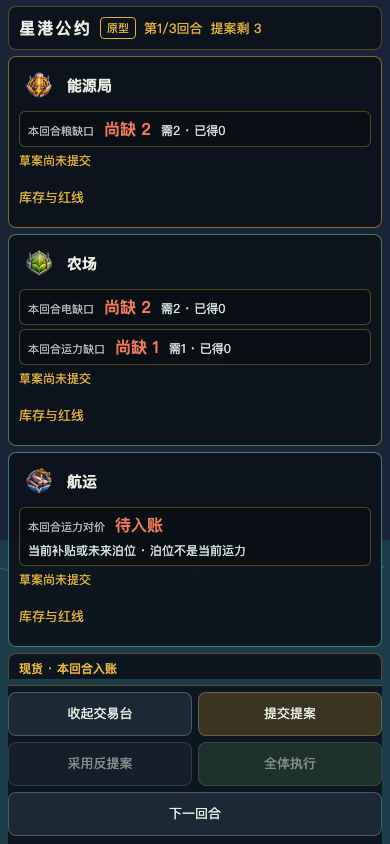
Read three ledgers, not just the proposed deal
Starport Compact is a three-round negotiation involving energy, farming and shipping interests. Start with the visible shortages and red lines for all three factions. Energy reserve, seed grain and shipping capacity are different constraints; a proposal that looks generous in one resource can still break another requirement.
Before drafting terms, separate resources held now, demand already satisfied this round and obligations due later. Those categories answer different questions. A large inventory number does not by itself prove that the public demand has been met.
Match the resource, recipient and execution round
Contract clauses can exchange resources, provide hauling or transfer a subsidy. Inspect who gives, who receives, the amount and the round in which the clause executes. A promise for a later round cannot repair an unmet immediate demand just because the amount looks sufficient.
For example, when the farm needs both power and hauling, check both shortfalls. Extra power does not automatically replace transport capacity. After a transfer, inspect the updated demand display instead of assuming the proposal has filled every gap.
Do not spend the same fulfilment twice
The game tracks what has actually reached the relevant demand during a round. Sending a resource back out can reduce that fulfilment. A circular exchange that leaves the same resource apparently useful to two sides is not a substitute for satisfying their real requirements.
When revising a contract, compare the ledger before and after execution. Ask what each faction can still provide while preserving its red line. A feasible transfer depends on the resulting balances, not merely on what the clause promises.
Future commitments must fit inside the horizon
The negotiation ends after three rounds. Check outstanding obligations before advancing, including the timing of any berth commitment. A future right needs a usable future round inside that horizon; a promise beyond the game does not settle a present crisis.
Do not treat a future delivery as stock that has already arrived. Use the obligation ledger to identify which commitments are due now and which resources must remain available for the next round. Advancing time is a decision with consequences for those commitments.
Audit each round before settling the crisis
Check the energy grain demand, the farm power and hauling demands, the factions' red lines and due obligations before advancing. The final crisis result considers the sequence of rounds, so a good final inventory cannot retroactively turn a missed earlier demand into a completed one.
On failure, read the named shortfall or outstanding obligation and trace it to the relevant transfer and round. Revise that commitment rather than adding an unrelated subsidy. This guide describes a method for auditing the three-round prototype, not a guarantee that every proposed deal will be accepted.
Continue playing
A three-round negotiation prototype with energy, farming and shipping interests. Contracts must respect each faction’s visible red lines.
Try the next attempt in Starport Compact. For a different game, browse the guide library. Report a rule that no longer matches the game through player support.