DualHook guide: hang points, rope control and cleaner landings
Use the load shape, centre of mass and actual contact marks to improve a two-rope lift across the two available jobs.
DualHook rules and controls · Play DualHook
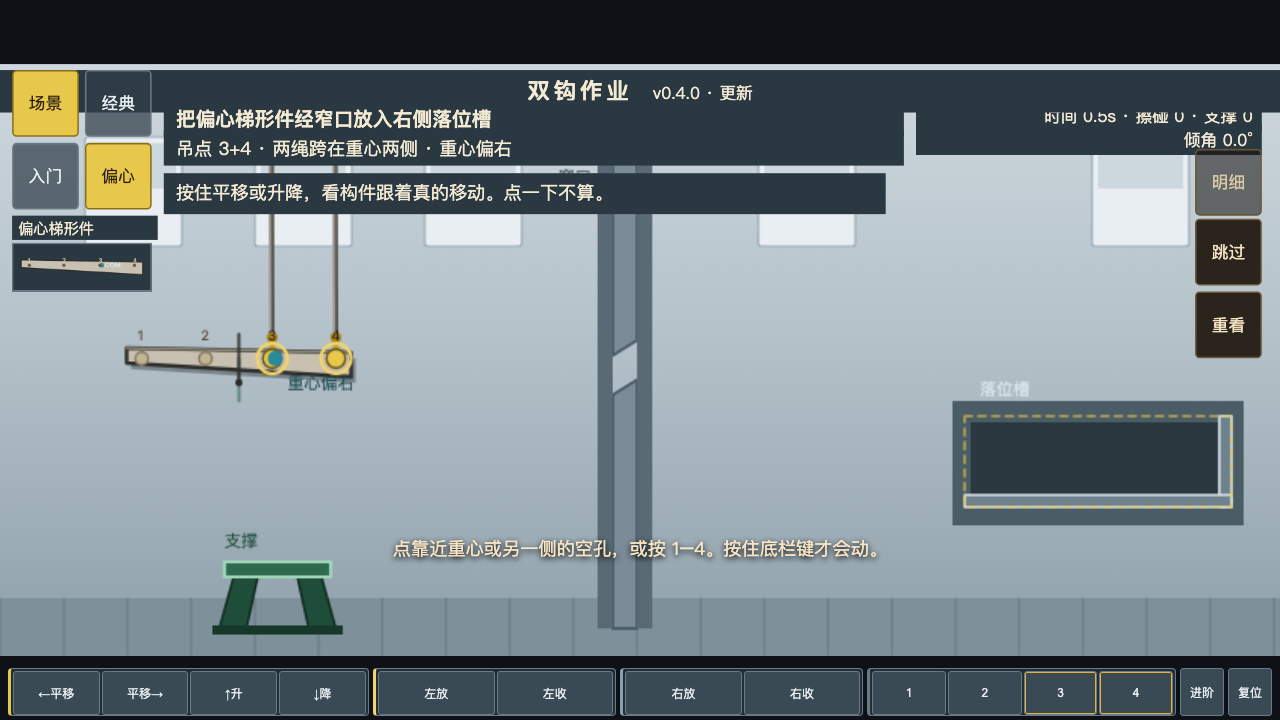
Read the load before touching the ropes
DualHook is a lifting puzzle with two jobs. You choose hang points on the workpiece, hold the two rope controls and guide the load through an opening into a target slot. The useful challenge is controlling the full shape, including its corners, rather than moving only its centre toward the destination.
Inspect the centre-of-mass indicator and the workpiece outline before lifting. On an off-centre load, a visually symmetrical pair of attachment points is not automatically the easiest arrangement to control. Your first attempt can establish how the selected pair responds.
Choose hang points with a testable purpose
Change the attachment pair, then make a short lift and watch both movement and tilt. If the load immediately rotates into an awkward position, compare a different pair instead of trying to correct every effect with longer button holds.
Keep the rest of the attempt similar when comparing hang points. Changing the attachments, rope pattern and intended path together makes it difficult to tell which change improved the clearance. There is no need to assume one pair is best for both available workpieces.
Separate overall lift from tilt correction
The two ropes let you affect the pose of the load. Watch the rope difference and the visible angle while holding a control. Short adjustments near the opening give you an opportunity to observe the response before the next correction.
When one corner approaches the wall, inspect the whole outline before increasing the lift again. More height does not necessarily create more clearance: a different tilt can move another corner into contact. Release, read the pose and make the next correction for the part that is actually close.
Use red contact marks as evidence
The red marks show actual collisions. After a scrape, note where the contact occurred and which way the load was turning. A final pose alone can hide the earlier point of impact, so the marked contact location is more useful than guessing from the end of the lift.
On the next attempt, change the hang points or rope adjustment responsible for that contact. If the approach becomes cleaner, preserve it while working on the landing. This turns repeated attempts into a comparison rather than a series of unrelated button holds.
Finish the landing and compare the recorded costs
Passing through the opening is an intermediate step. Guide the workpiece into the slot and wait for the actual result before treating the job as complete. Then compare the scraping and support costs shown for the attempt.
Use Retry to work on one part of the same job. The portrait view follows the workpiece, while landscape or desktop can make it easier to see the approach and target together. This walkthrough covers the two available lifting jobs, with no promise of additional stages.
Continue playing
Two lifting jobs with hang-point choice, two rope controls and a landing slot. Touch and landscape/desktop layouts are available.
Try the next attempt in DualHook. For a different game, browse the guide library. Report a rule that no longer matches the game through player support.